
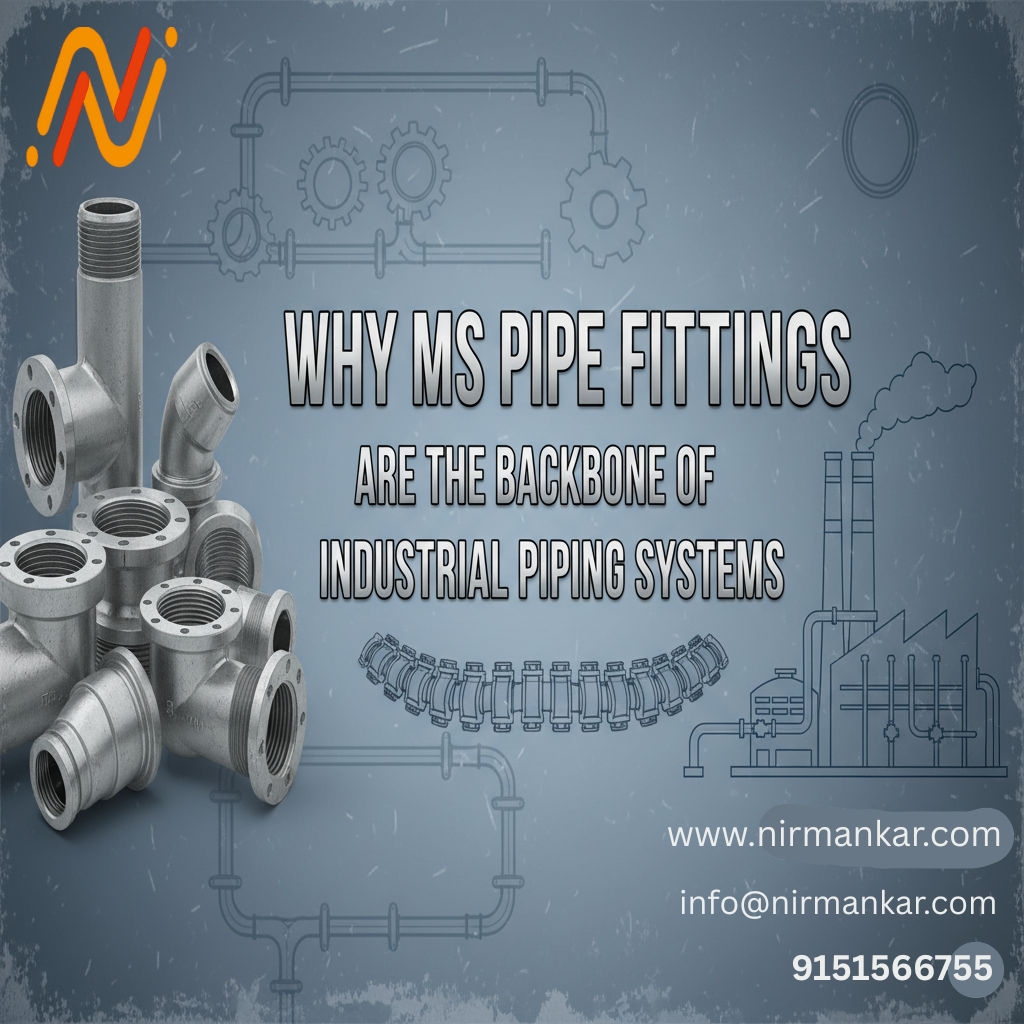
The performance of a piping network plays a crucial role in how well operations run in the industrial sector, where precision, strength, and long-term reliability really matter. A pipeline has to be tough, safe, and built to withstand constant wear and tear, whether it’s transporting gases, water, oil, steam, chemicals, or various other substances. While pipes take on the heavy lifting, it’s the fittings that really make the whole system work. Among all the materials out there, Mild Steel (MS) pipe fittings are the most trusted and widely used.
MS fittings are essential to countless systems across a range of industries, from small production facilities to large-scale plants. In this article, we’ll dive into why MS pipe fittings are seen as the backbone of industrial piping systems.
1.Unmatched Strength for High-Pressure Industrial Needs
Industries often operate under high pressures, extreme temperatures, and constant mechanical stress. MS pipe fittings are crafted with exceptional tensile strength, making them capable of handling these tough conditions.
Thanks to their solid construction, they offer:
Minimal wear and tear
Dependable performance under varying loads
Strong resistance to physical damage
This is why MS fittings are perfect for heavy-duty applications in sectors like refineries, shipbuilding, steel production, and power generation. Not many materials can match MS when it comes to strength and safety.
While steel is known for its strength, MS pipe fittings go even further. Manufacturers treat them with protective coatings—like epoxy, powder coating, black painting, and hot-dip galvanizing—to guard against corrosion and environmental damage.
These protective layers ensure:
Longer service life
Less frequent maintenance
Better performance in corrosive or humid environments
This reliability is critical for industries where downtime could cause significant financial losses. With MS fittings, operations can stay reliable, safe, and efficient for a long time.
One of the standout features of MS pipe fittings is their adaptability. You’ll find them in almost all industrial sectors, including:
Gas and oil pipelines
Water supply and purification plants
Safety and firefighting systems
Chemical processing units
HVAC systems
Irrigation and agriculture setups
Construction and fabrication sectors
MS fittings offer the flexibility to create complex piping systems, with options like elbows, tees, reducers, sockets, and unions. They’re readily available in various sizes, shapes, and pressure ratings, allowing engineers to customize systems to meet diverse operational needs.
Thanks to their great machinability and weldability, MS fittings make fabrication and installation a lot smoother. This quality lets engineers adjust fittings right on site.
They can:
Create leak-proof welded joints
Achieve perfect alignment in extensive pipeline networks
Complete projects faster and more economically
That’s why MS fittings are a go-to choice for new constructions and for maintaining or upgrading existing systems—they’re easy to cut, bend, weld, and shape.
Budget considerations are key in infrastructure development for many industries. MS pipe fittings are much more affordable than alternatives like stainless steel or alloys, yet they still deliver solid mechanical properties and reliability for the long haul.
Industries can see:
Lower upfront costs
Reduced maintenance expenses
High returns on extended use
This cost-effectiveness makes MS fittings ideal for large projects such as industrial facilities, commercial buildings, and urban water supply systems.
Since MS pipe fittings are produced in large quantities both in India and globally, they’re easy to find and meet standard specifications. Common MS fittings include:
Elbows (45°, 90°, long and short radius)
Reducers (concentric and eccentric)
Tees, crosses, and branch connectors
Couplings, unions, and sockets
Nipples, caps, plugs, and flanges
This extensive variety allows engineers to design elaborate and intricate piping systems accurately, ensuring smooth flow and functionality at every point.
Safety is a major concern in any industrial setting, especially in pipelines transporting steam, chemicals, or flammable materials. MS fittings are designed to create leak-proof joints, withstand high temperatures, and perform reliably in tough conditions.
Their dependability makes them vital for:
Fire suppression systems
Chemical processing plants
Power and utility networks
Fuel and oil transfer systems
When failure isn’t an option, MS pipe fittings are the trusted choice. In short, MS pipe fittings deliver a fantastic mix of strength, affordability, versatility, and durability. They’re what keeps industrial piping systems together, ensuring operations run smoothly, efficiently, and reliably over time. Whether you’re setting up a brand-new pipeline or upgrading an existing one, MS fittings are the solid support your infrastructure needs.