
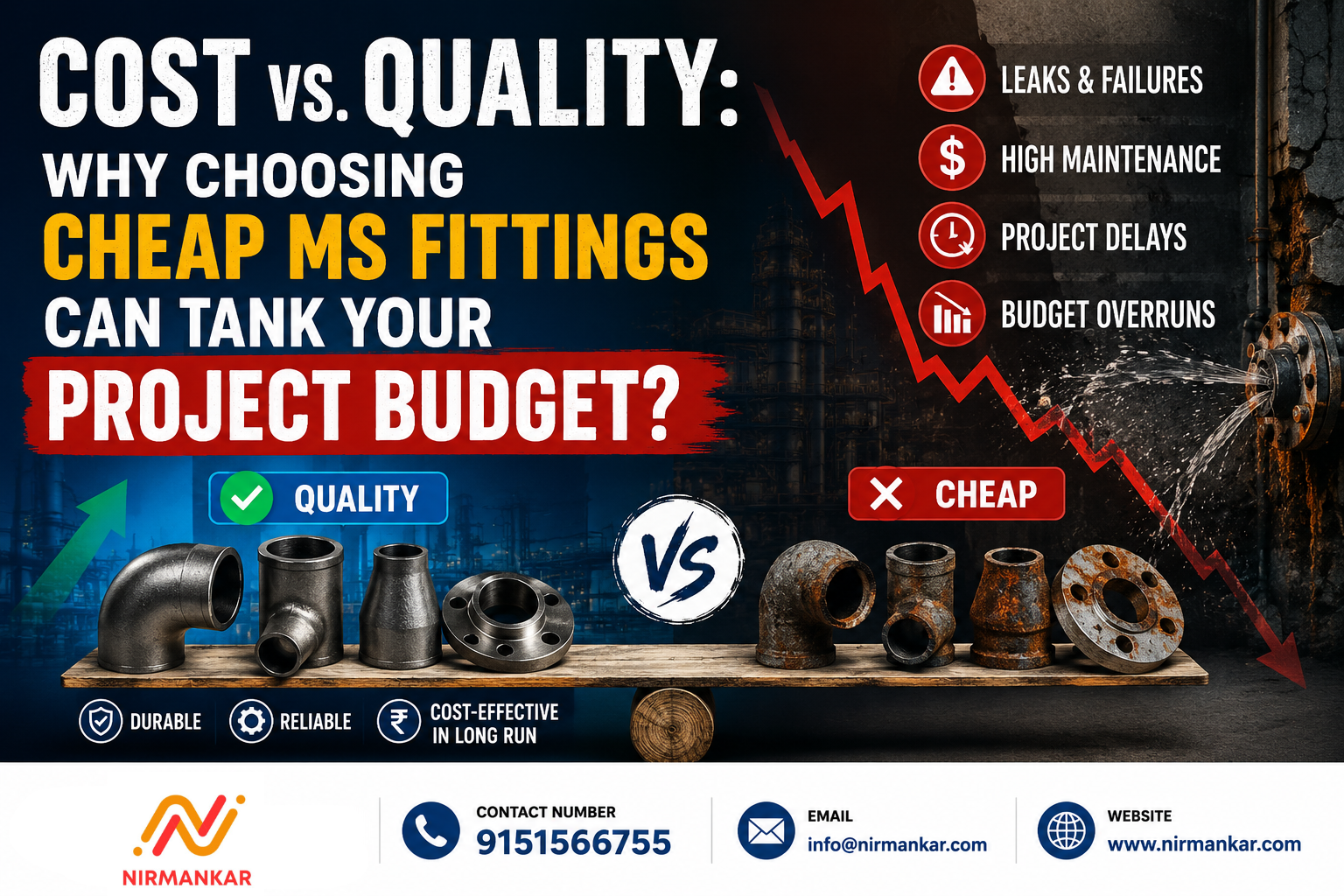
In industrial, commercial, and infrastructure projects, mild steel (MS) fittings—elbows, tees, reducers, flanges, couplings, and related components—form the backbone of piping systems. They carry fluids, gases, steam, or process media under pressure and temperature. When budgets tighten, the temptation to buy the cheapest available MS fittings is strong. That short-term saving often becomes one of the most expensive decisions a project can make.Cheap MS fittings rarely deliver true economy. Instead, they introduce hidden costs that cascade through installation, operation, maintenance, and even safety compliance—frequently wiping out the original savings many times over.
The False Economy of Low-Cost MS Fittings
At first glance, low-priced MS fittings look attractive. They may meet basic dimensional requirements on paper and allow procurement teams to report immediate cost reductions. In reality, these products often cut corners in critical areas:
These deficiencies do not always show up during visual inspection or hydrostatic testing at the site. Problems surface later—under operating pressure, thermal cycling, vibration, or corrosive service.
How Cheap Fittings Inflate Project Costs
Inferior metallurgy and manufacturing defects lead to cracking, pitting, or joint failure. A single leak in a process line can force shutdowns, product loss, environmental cleanup, and regulatory scrutiny. Repair costs quickly exceed the original price difference of the fittings.
Poor dimensional tolerances mean more time spent on fit-up, additional welding or grinding, and higher rejection rates during inspection. Labor and schedule overruns often dwarf the material savings.
Thin or poorly applied coatings, residual stresses, and non-uniform composition accelerate corrosion. Systems that should last 15–25 years may require major replacement in 5–8 years. Lifecycle cost analysis almost always favors quality components.
In manufacturing plants, power stations, or process industries, unplanned downtime is extremely expensive. The cost of lost output, emergency repairs, and expedited shipping of replacements can be orders of magnitude higher than the initial fitting price.
Failed fittings can cause injuries, fires, or environmental incidents. Insurance premiums may rise, and projects can face legal exposure or failed audits if materials lack proper traceability and certification (e.g., mill test certificates, third-party inspection).
Higher failure rates force larger spare inventories and more frequent emergency procurement, increasing holding costs and administrative burden.
Quality MS Fittings: The Real Cost Controllers
Reputable manufacturers of MS fittings i.e. ms elbow invest in controlled steel chemistry, proper forming and heat treatment processes, precise machining, rigorous non-destructive testing, and full material traceability. These fittings typically offer:
While the unit price is higher, the total cost of ownership is substantially lower. Industry experience consistently shows that spending moderately more on quality fittings reduces overall project expenditure through fewer failures, smoother installation, and extended asset life.
Practical Guidance for Buyers
Conclusion
Choosing cheap MS fittings is rarely a genuine cost-saving measure. It is a transfer of cost from the procurement line item into higher installation, maintenance, downtime, and risk costs—often with a multiplier effect. Projects that prioritize quality fittings protect schedules, budgets, safety, and long-term asset performance. In piping systems, the fittings are not the place to economize. The difference between a reliable, long-lasting system and one plagued by chronic problems frequently comes down to the quality of those seemingly small components. Invest wisely upfront, and the project budget—and the people who depend on the system—will thank you later.